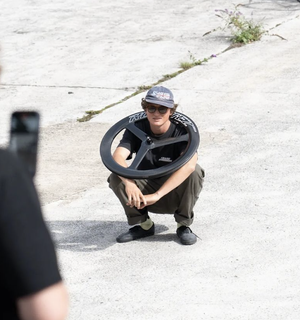
Learn How to Dance With Your Bike!
I know the title sounds a little philosophical, and be assured that this piece might feel as abstract as it is technical. But as I keep riding bikes and discovering new things about them, my instinct is always the same: to share those thoughts here on SSS once I feel I’ve learned enough to write something interesting.
As you probably know, when it comes to reviewing bikes I usually evoke geometries, tube lengths, thickness, and angles, because that’s what we nerds do. But that’s probably only the tip of the iceberg…. Over the past few years, I’ve slowly come to understand the real meaning of a frame that “feels stiff” and, conversely, one that feels more “springy.”
During a trip to Japan last winter, I had the opportunity to try a nearly final prototype of Weis’s new Tracklocross frame. After a few hours building it up and riding it, my immediate reaction was that the frame felt overly stiff, to the point where I was sensing that I was quickly losing momentum. And before you start going at me in the comments, I know that there is technically no momentum stored in the frame itself. Momentum comes in part from the total system mass (bike + rider), velocity, and the rotational inertia of the wheels.
But if the bike felt incredible in heavy traffic, carving between cars like a champ, I still struggled to move it the way I wanted on long, straight sections. It was so unyielding, in fact, that I wrote to the Weis team in Brooklyn to tell them exactly that and asked if there was something I was missing.
Due to its unique design, the Weis has an extremely rigid rear triangle. For more aggressive and dynamic riders, a frame that twists too much can feel soft, hesitant, or even out of phase with their pedal stroke. This often leads to subconscious compensation and an inability to fully deploy the power they want to put down.
That was clearly not the case here. While a stiffer rear triangle is beneficial for sprinting out of the saddle, producing very peaky torque, and short rides with intense efforts, it may not be the best option for long-distance rides, riders who stay seated most of the time, or those who are sensitive to fatigue and joint stress.
So it wasn’t that the bike was too "stiff"; it was simply me not being able to input the power correctly. The way I moved the bike and put energy through the pedals was not in phase with this specific frame.
But! And this is important… It doesn’t mean that it can’t be.
Even though what we call frame deflection (the temporary bending, twisting, or movement of a bicycle frame under load, caused by forces from the rider, drivetrain, and road) is partially driven by how much force a rider applies, it is also heavily influenced by body movement and weight transfer.
Which brings us back to the original title: Why should you learn how to dance with your bike?
We don’t live in a perfect world. Even though frame builders can create beautifully tailored bikes made for our exact needs, body and abilities, most of us will end up riding mass-produced frames. In an ideal scenario, every bike would be built around its rider, fitting like a glove. In reality, more often than not, you have to adapt to what you’re riding.
After some reflection, I realized that the way I pedal and infuse a bike with energy changes significantly depending on the frame I’m riding. This is especially true with fixed-gear bikes, where the direct drivetrain amplifies every sensation.
It’s worth noting that I’m speaking here about stiffer and flexier frames in a general sense. A frame can have a relatively soft rear triangle while still being extremely resistant to torsional forces around the head tube. Still, most frames do convey an overall impression of being more or less flexible.
On my Mash Parallax, generally considered a fairly rigid frame, my riding tends to become more aggressive. I segment my rides into a series of small bursts of energy, intertwined with all sorts of “events”: side skids, bunny hops, and sharp turns. Every excuse is good to prematurely break momentum, just to get out of the saddle and sprint again.
On my No. 22 Little Wing, which is more springy and clearly encourages smooth riding and longer seated efforts, my focus shifts. I pay more attention to my pedal stroke, trying to make it as round as possible, and to how I flow within my surroundings. It’s the kind of bike that keeps you moving through added comfort and micro-compliances.
I know that my riding style, preferences, and overall power output naturally push me toward the softer side of the spectrum. That said, I still really enjoy riding something much stiffer from time to time, just to experience that instant power-transfer feeling.
But hold up! You’ve probably also seen Keirin racers or professional road cyclists with high power output preferring frames that are overall more flexible. How can that be?
If your pedaling is smooth, the frame flexes predictably, and you’ll end up working with the bike’s movement instead of fighting it. With this in mind you can fully exploit the potential of a softer frame. Easy to say, much harder to master, and, once again, deeply subjective.
So, once again, how do you dance with your frame?
Learning how a bike feels is the key to extracting the most from it. Ideally, you reach a point where the handling feels neutral and the bike becomes fully predictable under load. When that happens, the bike stops feeling like a tool you’re sitting on and starts to truly be an extension of your body.
How do you get there?
Not by reading geometry charts or chasing numbers. You get there by spending time on the bike, paying attention to how it reacts when you push, pull, relax, or let it flow. By learning when to make it yield, but more importantly, when to stop fighting at all.
At some point, something clicks, the bike becomes predictable, almost quiet, and your movements sync with its responses.
And that’s what we’re looking for.
There is (to my knowledge) no shortcut to that moment, but some bikes will get you there faster than others. You earn it the only way it’s ever been earned: by going outside, riding your bike, and letting the distance teach you how to dance.
That’s it for this piece! A huge thanks to @juliettejoe_ for the illustrations in this article and to Weis MFG for letting me use their Tracklocross prototype for a couple of months.
Do you dance?